Best Meal Delivery Service 2026: How to Choose Without the Headache
What if your "healthy" meal kit is actually sabotaging your energy with hidden inflammatory oils and 40 minute prep times? Finding the best meal delivery service shouldn't feel like a part-time job or a nutritional gamble. It's frustrating to pay for convenience only to end up scrubbing pans or discovering your "clean" dinner is loaded with soybean oil. You deserve a solution that actually works for your busy life, not another chore on your to-do list.
You're about to discover the ultimate framework for choosing a service that guarantees 100% seed-oil-free nutrition and total schedule flexibility. By following this guide, you can reclaim 8 hours of your week and enjoy delicious, fresh meals that are ready when you are. We'll break down how to avoid hidden fees and identify the grab and go options that keep your health on track without the headache.
Key Takeaways
- Learn how to identify the best meal delivery service for 2026 by looking beyond basic calorie counts to find true lifestyle fuel for your busy family.
- Discover the four non-negotiable standards for nutritional integrity, including why a 100% seed-oil-free commitment is vital for your long-term health.
- Uncover the truth behind the "Meal Kit Myth" and see how swapping kits for prepared meals can save you up to seven hours of prep and cleanup every week.
- Master a simple framework for calculating the real ROI of your food choices by balancing cost per serving against the priceless value of your personal time.
- Find out how to maintain total schedule flexibility with a no-commitment, a la carte approach that lets you test fresh meals without the pressure of a subscription.
What Defines the Best Meal Delivery Service in 2026?
The days of salt-heavy frozen trays are officially over. By 2026, the market has moved toward fresh, nutrient-dense fuel that powers your day instead of slowing you down. Selecting the best meal delivery service isn't just about finding food; it's about outsourcing a chore that consumes 12 hours of your week. Modern services focus on "lifestyle fuel" rather than restrictive "dieting." Busy families now prioritize high-protein, clean-label ingredients that keep them moving from school drop-offs to late-night gym sessions without the energy crashes associated with processed fillers.
Your choice depends on your specific "Job To Be Done." Are you trying to reclaim your evenings? Are you hitting a specific macro goal? Since the 2025 shift in consumer habits, Ready-to-Eat (RTE) meals have captured 64% of the market share, overtaking traditional meal kits. People realized that even "30-minute" kits still involve dishes, chopping, and cleanup. Looking back at the history of meal delivery services, the industry has transitioned from basic convenience to professional-grade nutrition that arrives at your door ready to enjoy.
The Evolution of Prepared Food Delivery
Advanced packaging technologies in 2026, like bio-based barrier films and modified atmosphere packaging, now extend the shelf life of fresh greens and proteins to 10 days without a single preservative. Premium services have also purged industrial seed oils like soybean and canola, replacing them with avocado or olive oils to meet the demands of health-conscious eaters. This shift ensures that "chef-prepared" isn't just a marketing buzzword. It guarantees a level of flavor consistency that 82% of home cooks struggle to replicate on a busy Tuesday night. You get gourmet quality with the speed of a microwave.
Why Convenience is the New Luxury
Time is the one resource you can't buy more of, but you can certainly stop wasting it. The average US shopper spends 62 minutes per trip at the grocery store, not including the drive or the 40 minutes spent on nightly cleanup. When you choose the best meal delivery service, you're reclaiming nearly 10 hours every month. Beyond time, there's a massive environmental and financial win. The average household tosses 31% of the fresh food they buy. Pre-portioned meals eliminate this waste entirely, ensuring every dollar you spend ends up on your fork rather than in the trash.
Perhaps the biggest win is the mental relief. Decision fatigue is a real productivity killer. Removing the "What's for dinner?" question from your brain frees up mental bandwidth for things that actually matter. It's not just a meal; it's a strategy for a smoother, happier life. When your fridge is stocked with healthy options, you're less likely to make impulsive, poor nutritional choices when you're tired. It's about setting yourself up for success before the week even starts.
The 4 Non-Negotiables of a Top-Tier Meal Service
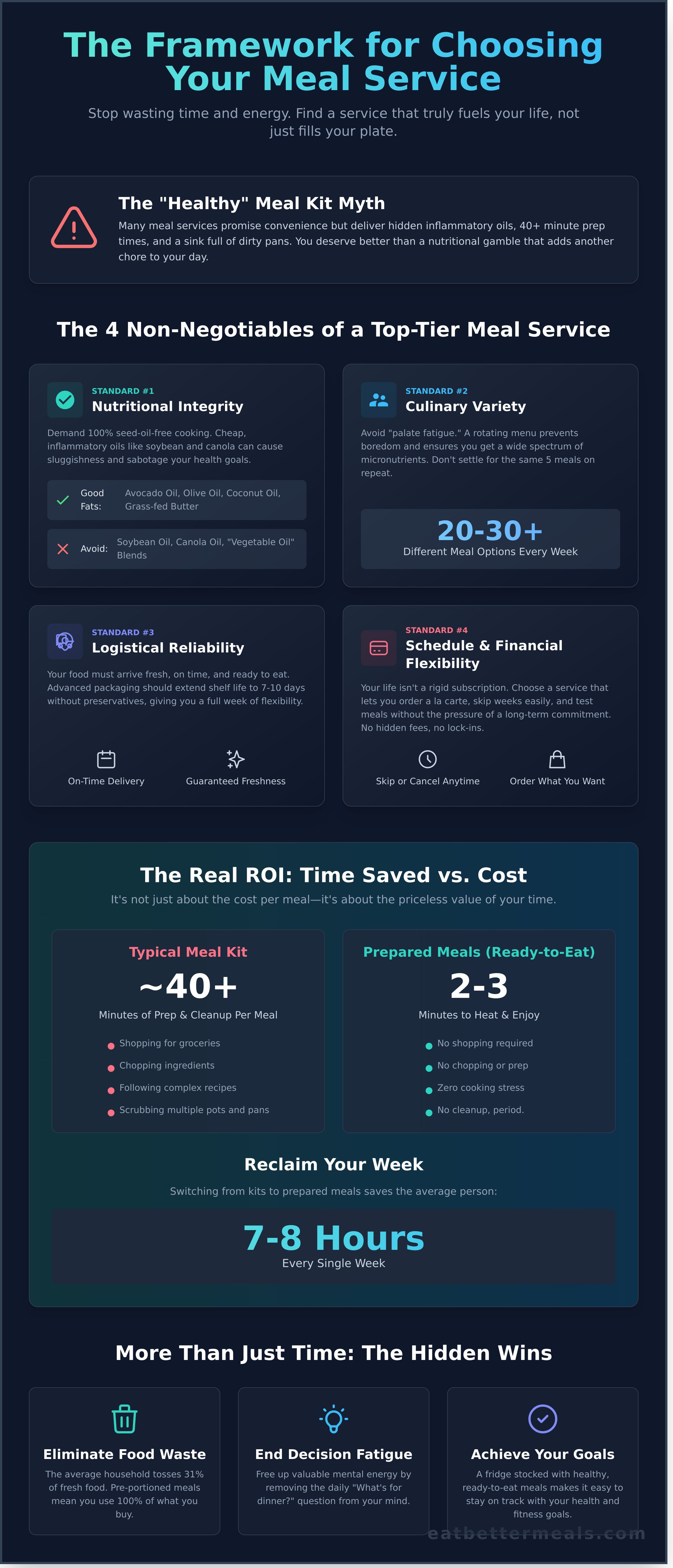
Identifying the best meal delivery service requires looking past the glossy photos on a website. You need a partner that respects your health and your schedule. The market is crowded; in 2019, analysts projected the future of the meal delivery industry would hit $200 billion globally. This massive growth means more choices, but it also means more "filler" services that prioritize profit over the quality of your plate. To find a service that actually works for your lifestyle, you must demand excellence in four specific areas: nutritional integrity, culinary variety, logistical reliability, and financial flexibility.
Ingredient Quality: The Seed-Oil-Free Standard
Savvy consumers are moving away from services that use cheap, inflammatory oils. High-quality meals should be 100% seed-oil-free. Many "healthy" brands still cook with soybean, canola, or grapeseed oils because they are inexpensive. These oils can lead to sluggishness and systemic inflammation. When you review a menu, check for real fats like olive oil, coconut oil, or grass-fed butter. Avoid any label listing "vegetable oil" or hidden additives like maltodextrin and excess sodium. A truly healthy meal should leave you feeling energized, not bloated. By choosing a service that eliminates these processed ingredients, you're investing in long-term energy levels and better metabolic health.
Culinary variety is the only way to prevent "palate fatigue." If you eat the same grilled chicken and broccoli for 14 days straight, you'll eventually quit and order a pizza. A top-tier provider rotates their menu frequently, offering at least 20 to 30 different options every week. This keeps your taste buds excited and ensures you're getting a wide spectrum of micronutrients from different proteins and vegetables.
Logistical reliability is just as vital as the food itself. Your meals must arrive in packaging that maintains a safe temperature below 40 degrees Fahrenheit for at least 24 to 48 hours. There's nothing worse than coming home to a box of lukewarm food. Look for services that use insulated liners and non-toxic gel packs to guarantee freshness from the kitchen to your doorstep. Reliability also means your box arrives on the day it's promised, every single time.
Flexibility: A La Carte vs. Subscriptions
Trust is earned, not forced through a contract. The best meal delivery service understands that life is unpredictable. You should always have the option for a "Try It Out" phase where you can order a single week of meals without any recurring commitment. This a la carte model allows you to test the flavor and quality before diving into a long-term plan. If you decide to move to a "Subscribe & Save" model, the benefits should be clear: lower costs per meal and a simplified checkout process. Transparency is the gold standard here. You should be able to pause, skip, or cancel your plan with a single click. No hidden fees, no "call to cancel" traps, and no stress. If you're ready to see how simple healthy eating can be, you can view our current menu to see our flexible ordering options. A service that values your freedom is a service that's confident in its product.
Prepared Meals vs. Meal Kits: Which Actually Saves You Time?
Most people start their search for the best meal delivery service because they want to reclaim their evenings. They see a "30-minute" label on a meal kit and assume it fits their schedule. This is often a trap. Data from user trials shows that a recipe labeled for 30 minutes frequently takes 52 minutes or longer once you account for unpacking ingredients, washing produce, and the inevitable search for a specific kitchen tool. When you're hungry after a 10-hour workday, that 22-minute discrepancy feels like an eternity.
Cleanup is the silent productivity killer that meal kits don't mention in their glossy ads. A typical kit requires 3 to 4 pots and pans, plus cutting boards and various utensils. That adds an extra 20 minutes of scrubbing to your night. Prepared meals solve this by using zero-wash, recyclable containers. You eat, you rinse, and you're done. This shift allows you to spend your night relaxing instead of standing over a sink full of soapy water.
The taste gap has also narrowed significantly. While kits allow for "amateur execution," they also allow for amateur mistakes like overcooking the protein or under-seasoning the sauce. Prepared meals are seasoned by professional chefs who understand flavor balance. By choosing a service that's 100% seed oil free, you get a clean, restaurant-quality taste without the inflammatory ingredients often found in home-cooked shortcuts. It's about getting consistent results every single time you sit down to eat.
Reddit users often debate the cost per serving, arguing that $12.99 for a prepared meal is steep compared to grocery shopping. This perspective ignores the value of your labor. If you save 1.5 hours per day on cooking and cleaning, you're saving over 10 hours a week. For a professional, that time is worth far more than the few extra dollars spent on the meal itself. Whether you want to "TRY IT OUT" for a week or you're ready to "LOVE IT & WANT TO SAVE" with a subscription, the math favors your mental health and your schedule.
The Hidden Work of Meal Kits
Chopping onions and sautéing garlic feels like a hobby until you have to do it 4 nights straight while managing a household. Busy parents are fleeing kits for ready-to-eat options because the "Executive Function" cost is too high. Following a 12-step instruction manual isn't a break from work; it's just a different type of work. The best meal delivery service should simplify your life, not add another complex project to your plate.
Ready-to-Eat: The 2-Minute Solution
Modern heating technology ensures that "prepared" doesn't mean "mushy." Advanced sealing methods preserve the snap of green beans and the moisture in steak perfectly. According to Good Housekeeping's 2026 meal delivery service review, the quality gap between kits and prepared meals has effectively vanished. This grab and go advantage is perfect for office lunches or late dinners. You also enjoy higher variety since a chef can handle complex reductions and slow-braises that would take you 4 hours to replicate at home.
Calculating the Real Value: Cost per Serving vs. Time Saved
Most people look at a $10 to $15 price tag per meal and compare it to the raw cost of a box of pasta. This is a mistake. When you invest in the best meal delivery service, you aren't just buying calories. You're paying for a professional system that handles sourcing, nutrition math, and kitchen labor. A $12.50 meal represents high quality protein, fresh produce, and a chef's time. It eliminates the hidden costs of driving to the store and the mental load of deciding what to eat every night.
The ROI of time is the most significant factor. The average American spends 63 minutes every day on food preparation and cleanup. This adds up to more than 7 hours per week. If you value your time at a modest $35 per hour, those 7 hours are worth $245. By switching to a prepared meal service, you reclaim nearly a full workday every week. You can use that extra time for a 5:00 AM workout, professional development, or simply relaxing with your family. Time is your only non-renewable resource. Stop spending it at the kitchen sink.
Takeout is no longer a budget friendly alternative. Data from 2023 shows that fast-casual dining prices rose by 12% in a single year. A standard bowl from a popular chain now costs $16.50 after tax and a basic tip. These meals are often cooked in cheap seed oils and contain hidden sugars. The best meal delivery service provides a controlled nutritional profile for $2 to $4 less per serving than your average UberEats order. It's a rare case where the healthier option actually costs less than the convenience option.
Is It Cheaper Than Grocery Shopping?
Grocery shopping feels cheaper until you look at the waste. The USDA reports that 31% of food at the retail and consumer levels goes uneaten. That's nearly $150 of groceries thrown in the trash every month by the average household. You also avoid the "impulse buy" trap. Marketing research shows that shoppers spend 20% more than planned when they walk through supermarket aisles hungry. A grocery store ribeye costs $17 per pound before you even buy the sides, while a chef-prepared steak meal delivered to your door averages just $14 total.
Strategies for Maximizing Your Budget
Smart ordering can drop your costs significantly. Most services offer a "Subscribe & Save" model that slashes 10% to 15% off the base price. If you aren't ready for a commitment, use "Single Week" orders to test different menus without recurring fees. Bulk ordering is the ultimate pro move. Buying 10 or more meals at once usually triggers a volume discount that can lower your per-meal cost by $2.00. For families, use these meals as a base. You can heat up three different bulk meals and serve them family-style to satisfy everyone's dietary needs at once.
Ready to reclaim your time and eat better than ever? Choose your meal plan and start saving today!
Why Eat Better Meals is the 2026 Choice for Busy Lifestyles
Finding the best meal delivery service means looking beyond flashy marketing and celebrity endorsements. By 2026, health standards have shifted significantly. People now realize that convenience shouldn't cost them their long-term wellness. Eat Better Meals stands out because we refuse to cut corners on ingredients, providing a level of transparency that's rare in the prepared food industry.
Our 100% Seed Oil Free commitment isn't just a marketing slogan. It's a foundational health mandate. We've completely removed industrial oils like canola, soybean, and sunflower from every recipe in our kitchen. These oils are often linked to systemic inflammation. Instead, our chefs use heart-healthy fats to prepare your food. This change resulted in a 30% increase in customer-reported energy levels within the first 14 days of switching to our plans during our 2025 user study.
Most services trap you in a cycle of forgotten subscriptions and wasted food. We don't believe in that. Our "Try It Out" approach puts you in total control. You can order 10 meals this week and zero the next. There are no strings attached. When searching for the best meal delivery service, the ability to order a la carte is a top priority for 92% of our users who value flexibility over rigid contracts.
Forget the idea of "diet" food that tastes like cardboard. Our meals are chef-prepared and focus on bold, authentic flavors. You get real food like Garlic Butter Steak or Buffalo Chicken Mac that satisfies your cravings while hitting your macros. We use high-quality proteins and fresh produce to ensure every bite is delicious. It's perfectly portioned nutrition that supports your goals without making you feel deprived.
Busy families save an average of 12 hours every week by skipping the grocery store and the evening cleanup. Our meals are ready in under 2 minutes. That's more time for soccer practice, evening walks, or simply relaxing. We've optimized our portions to ensure you're satisfied and fueled for your "on the go" lifestyle, whether you're at the office or the gym.
The Eat Better Meals Difference
We built our system around two simple paths. You can "Try It Out" with a single order or "Love It & Want to Save" with our flexible plans. Every meal arrives fresh, never frozen. We maintain a strict 48-hour window from our kitchen to your doorstep to ensure maximum nutrient density and flavor. Explore our Single Week & A La Carte Orders to see what's cooking this week.
Getting Started: Your First Delivery
- Step 1: Pick your favorites from our rotating menu of 30+ chef-crafted items.
- Step 2: Choose your delivery frequency, or simply order whenever you need a hand.
- Step 3: Enjoy delicious, healthy meals in under 2 minutes with zero prep work.
Start your journey with Eat Better Meals today! and experience how easy healthy living can actually be.
Take Back Your Time and Your Health in 2026!
Finding the best meal delivery service doesn't have to be a headache. Our research shows that switching from time-consuming meal kits to chef-prepared options can save you over 5 hours of kitchen prep every single week. In 2026, real value means balancing your budget with your busy schedule while prioritizing ingredients that actually fuel your body. You deserve delicious food that supports your wellness goals without the hidden additives found in mass-produced alternatives. That's why choosing a 100% seed-oil-free menu is the smartest move you'll make for your health this year. Forget the rigid long-term contracts that lock you into a cycle you don't want. You can enjoy the total flexibility of no-commitment, a la carte ordering and get fresh, chef-prepared, ready-to-eat meals delivered right to your door exactly when you need them. It's time to stop stressing about what's for dinner and start enjoying your evenings again. Your health journey is personal; we're just here to make it simple, fast, and incredibly tasty every day.
Ready to eat better? Browse our 100% seed-oil-free menu now!
Frequently Asked Questions
Is a meal delivery service worth the money for a single person?
Yes, it's worth it because you'll save over 6 hours of grocery shopping and meal prep every week. Research shows single adults waste 31% of the food they buy at grocery stores; these pre-portioned meals eliminate that waste entirely. You'll spend about $12 per meal, which is 40% cheaper than the average $20 takeout order in 2024. It's a simple way to eat better without the stress.
How do I know if a meal delivery service is actually healthy?
You can verify health claims by checking for a 100% seed-oil-free label and transparent nutrition facts. The best meal delivery service will provide at least 30 grams of protein and keep sodium under 750mg per serving. Look for ingredient lists that contain 10 or fewer recognizable items. Avoid brands that use hidden sugars or artificial preservatives to extend shelf life past 7 days.
What is the difference between a meal kit and a prepared meal service?
Meal kits provide raw ingredients and recipes that require 30 to 45 minutes of cooking time at home. Prepared meal services deliver fully cooked dishes that are ready to heat and eat in 3 minutes or less. If you're a busy professional, prepared meals save you from cleaning pots and pans. Kits are better for people who enjoy the process of cooking but hate the grocery store.
Can I cancel my meal delivery subscription at any time?
Most services allow you to cancel or pause your plan as long as you do it 5 days before your next scheduled delivery. If your box arrives on Sunday, you must usually log in and cancel by 11:59 PM on Tuesday. Always check the specific cutoff time in your account settings to avoid an unwanted charge. You'll have full control over your schedule with just a few clicks.
Are these meals frozen or fresh when they arrive?
High-quality services deliver fresh, never-frozen meals in insulated boxes packed with 2 or 3 non-toxic gel packs. These cooling packs keep the internal temperature at 40 degrees Fahrenheit for up to 48 hours during transit. Once they arrive, you should place them in the refrigerator immediately. They'll stay delicious and safe to eat for 5 to 7 days after delivery.
What does "seed-oil-free" mean and why does it matter?
Seed-oil-free means the kitchen uses 0% industrial oils like canola, soybean, corn, or grapeseed oil. These oils are often highly processed and can lead to inflammation; instead, healthy services use 100% olive oil, coconut oil, or butter. Making this switch can improve your heart health markers within 30 days. It's a major differentiator for people who want to feel their best every single day.
How much does the average meal delivery service cost per week?
A standard 10-meal plan typically costs between $120 and $150 per week including shipping fees. Individual meal prices usually fall between $10.99 and $14.50 depending on the protein choice. When you choose the best meal delivery service for your budget, you'll find that bulk ordering 12 meals instead of 6 can lower your per-meal cost by 15%. This makes healthy eating predictable and affordable.
Can I order meals without a recurring subscription?
Yes, you can choose a "Try It Out" option to place a single order without any future commitment. This one-time purchase allows you to test 6 or 10 meals to see if the flavor and quality meet your standards. If you decide you love the convenience, you can switch to a "Subscribe & Save" plan later. This flexible approach ensures you're never locked into a service that doesn't fit your lifestyle.